OVERVIEW--Fighting global warming
The scientific evidence is clear that the earth is warming and that human activity--mainly the burning of fossil fuels--is a primary cause. Signs of global climate change are already apparent: disappearing glaciers, increasingly severe heat waves and droughts, extreme weather events, dying coral reefs, disrupted ecosystems, and more. Strong action to cut global greenhouse gas emissions is needed now if we are to avoid irreversible damage to our planet.
Individual citizens and governments at all levels have important roles to play in addressing the enormous challenge of climate change. Reducing energy consumption, increasing our reliance on renewable energy sources, making use of energy-efficient technologies, setting high energy performance standards--all are important strategies for reducing greenhouse gas emissions.
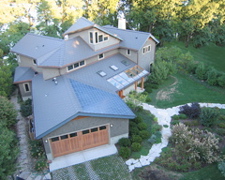
With this in mind, a major goal in building this house was to make it as carbon-neutral as possible. Although performance results to date are more modest than projected originally, the house has achieved a significant level of energy efficiency. In their daily monitoring of their energy usage, the owners find that they are using 70 percent less electricity and 60 percent less gas than they did in their former 1920s house, which was of comparable size. And in a home energy audit, the house earned a Home Energy Rating System (HERS) Score of 92.7 for certification as an ENERGY STAR home.
[When the audit was conducted, in 2003, the higher a home's HERS Score, the more efficient the home. A score of at least 86 was required to meet ENERGY STAR standards at that time. In 2006, the HERS Index replaced the HERS Score. With this rating system, the lower the value the better. A HERS Index of 100 represents the energy use of a standard new home, while a net zero energy home has a HERS Index of 0.]
Outlined below are the major aspects of design and construction that have contributed to the high energy performance of the house.
Designing for efficient use of land and energy
The new house occupies less ground area than the previous 1950s house on the property, and it is less than one-third the size that local zoning would have permitted. While it can be argued that tearing down a house is wasteful in and of itself, it is also true that current building practices can produce structures which are much more energy efficient, as is the case with this house.
Although the new house is relatively large (4,000 square feet, plus basement and garage), an obvious design objective was to take full advantage of the site's dramatic views of Lake Michigan. The open floor plan was intended to accommodate midsized groups of people attending civic and charitable events hosted by the owners. Moreover, the house conforms to some "small house" principles, such as flexible uses of certain spaces. The first-floor guest room is used as a TV room and library, for example; the sunroom is used for small meetings with colleagues and students; and the second-floor home office could become a fourth bedroom.
Design features which contribute to energy efficiency include the vestibule (airlock) at the front entry that keeps cold winter air from entering the main part of the house, the centrally located, open stairwell creating natural stack ventilation, tall windows and skylights that provide light deep into living spaces, and orientation of major windows to the south for passive solar gain.
The house is designed to allow the owners to age in place and also to welcome visitors with disabilities. There are no steps at the front entrance, doors on the ground floor are wide enough to accommodate a wheelchair, and the first floor bathroom features an accessible sink, a walk-in shower, and multiple grab bars. The owners also made provisions to allow for the addition of an elevator, should one be needed in the future.
Reducing energy consumption
The owners have taken many steps to reduce their energy consumption, and many of these are reflected in the design and use of the house:
- Compact fluorescent lights (CFLs) are used in almost all the light fixtures.
- Exterior landscape lighting is solar-powered.
- Ceiling fans in the main living areas and natural ventilation minimize the need for air conditioning except on the very hottest of days.
- Window shades are used routinely--to block the heat of the sun in summer and to retain heat at night during the winter months.
- Appliances (dishwasher, clothes washer and drier) meeting Energy Star standards were selected.
Heating the house
Solar hot water collectors provide most of the heat for domestic hot water and are a secondary source of heat for the radiant floor heating system. Excess heat is transfered to a basement exercise pool. The Illinois Department of Commerce and Community Affairs (now called the Department of Commerce and Economic Opportunity) contributed $5,000 towards the cost of the system through its Renewable Energy Resources Rebate Program.
A highly efficient advanced combustion fireplace serves as an additional source of heat. Natural-gas-fired boilers complete the heating system.
Producing electricity
Photovoltaic slates on the three south-facing roof surfaces generate roughly 80 percent of the total electricity consumed over the course of the year. On sunny days, excess electricity generated is sold to Commonwealth Edison, which in turn provides electricity to the house on cloudy days and at night. A battery back-up system is in place and will provide electricity to key systems and appliances in the event of a ComEd power failure. A state grant of $6.00/watt contributed $38,300 toward the considerable cost of purchasing and installing the 6.4 kilowatt PV system.
Using renewable, recycled, and locally available materials
Building materials selected for the house were predominantly those having a low environmental impact. Certified wood and engineered lumber were used in the basic construction of the house, alternatives to wood were selected for the flooring, and recycled wood was used as a design element in several locations. Regional availability was a factor in the choice of the stone used for some flooring and for the terrace. Tiles made from 100-percent recycled glass were used for the kitchen backsplash.
Conserving water
Dual-flush toilets were installed, reducing the owners' water consumption by an estimated 5,000 gallons/year. Permeable driveway pavers stop rain water runoff into the storm sewers and replenish the water table. Roof gutters direct rainwater into a 1000-gallon underground cistern for use in watering the garden. And the low-maintenance landscaping includes grasses and other drought-resistant plants.
|