for its High Performance Buildings Database
U.S. Department of Energy - Energy Efficiency and Renewable Energy
Building Technologies Program - Buildings Database
Team & Process
Predesign
Two seemingly contradictory goals of the pre-design and design phases were to minimize the environmental impacts of constructing and operating a new home while simultaneously building a house suitable for its spectacular location on Lake Michigan and within walking distance of a major university. Taking full advantage of the dramatic lake views afforded by the site was a clear design priority. It was also important that the house be large enough to accommodate mid-sized charitable events for local nonprofit organizations and allow the owners to share the beauty of the lakefront with friends and colleagues.
Although the design result was a house that is large for a project with ambitious sustainable design goals--4002 sq feet, plus basement--it is considerably smaller than could have been built by right under the local zoning ordinance. Zoning would have allowed construction of a house almost four times the size of this project, but the owners entered instead into a voluntary covenant with their neighbor to the south to preserve as open space a large portion of the land between their two houses.
The architect and owners also focused relentlessly on maximizing the energy efficiency of the design, materials, and construction of the house. During the pre-design phase, advice was sought from several energy consultants, but their thinking was limited to what is typically done in the upper Midwest rather than what could be done by adapting strategies from other parts of the country and by seeking out newer technologies. As a result, most of the technical information and analysis needed for the project came from the owners' own online research and calculations.
Design
The design phase was an exciting collaboration between architect and owners as they worked to realize project goals, emphasizing sustainable or renewable building materials, minimal site impact, and a highly energy-efficient design compatible with the location of the house. They continued to explore new approaches and strategies throughout the design phase and well into the construction phase of the project, adding new resource-efficient features and pursuing alternative solutions where needed as they gained new information and expertise.
Construction
The primary contractor and most subcontractors became enthralled with the opportunity to design it right, build it tight, and ventilate it right. In particular, the electricians and carpenters learned many new skills and building concepts as the work progressed.
Operations/Maintenance
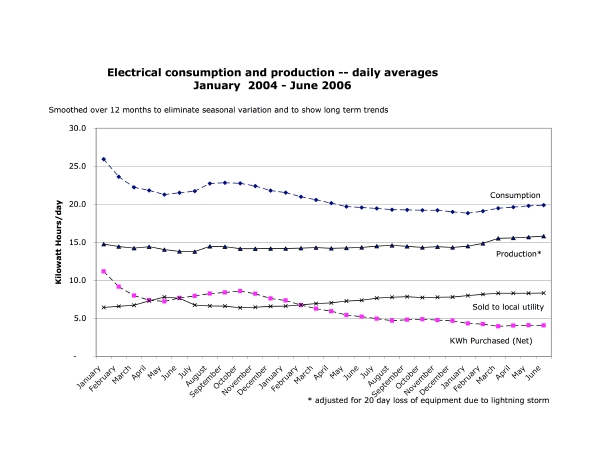
The owners have been in the house for three years. During that time, they have learned to manage the heating and ventilation systems to reduce the total electrical demand a further 17 percent, which has reduced the average daily KWH load from the grid from 8.6 KWH/day to 4.0 KWH/day. After an electrical storm in September 2005 knocked out one of the three charge controllers for the PV system, they replaced it with one that is running 18-20 percent more efficiently. Based upon this performance, they replaced a second charge controller.
Post-Occupancy
The owners monitor the energy systems on an almost daily basis. (See accompanying figure showing KWH/day data.) This monitoring allows them to evaluate the performance of the house--e.g., the relative efficiency of the charge controllers; the thermal output of the high-efficiency fireplace--and to determine where additional energy savings can be achieved.
Useful Information Resources and Software
- The web, with search engines such as Google, led to the National Renewable Energy Labs and their pages. Their solar flux calculator was particularly helpful. Other particularly useful pages were those of Natural Resources of Canada.
- Basic statistical modeling software, including Excel and R.
- Apache (web server software): The owners developed a web page (http://revelle.net/lakeside) to help them organize and share the information they were learning with their architect, contractors, and each other.
Primary Design Team Members
Ellen GallandRockwell Associates Architects
Architect
Evanston, IL
U.S.A.
http://www.rockwellassociates.net/
Steve Sturm
Sturm Builders, Inc
Contractor
Northbrook, IL
U.S.A.
Tor Faegre
Artist for stair railing and screen
Evanston, IL
U.S.A.